

Blind Dog Halo — Padded Anti-Bump Halo Harness for Blind & Senior Dogs


Blind Dog Halo — Padded Anti-Bump Halo Harness for Blind & Senior Dogs
Their world got smaller.
This gives part of it back.
When a dog starts losing their sight, the house turns into a minefield. Table legs. Doorframes. The corner of the couch at 3 a.m. A padded ring sits in front of the face, so an obstacle is touched before it becomes a bump.

He isn’t being stubborn.
He’s bracing for the next hit.
A dog who has started bumping into things doesn’t stop walking because he’s lazy. He stops because every step has turned into a guess. These are the things owners describe in the first weeks — and almost none of them show up in a product photo.
The head-first walk
He hugs the wall, keeps his nose low and still clips the doorframe on the way through. You hear it before you see it.
The freeze
Halfway across the living room he simply stops. Standing still feels safer than guessing where the coffee table went.
The 3 a.m. thud
He paces at night and you wake up to the sound of his head against a door. Nobody sleeps well after that.
The eye he keeps scraping
A bumped eye can turn into an ulcer, a stain, a vet visit. A blind dog can’t see the corner coming in time to duck.
The house you keep rearranging
Gates in every doorway, cushions on the table corners, carrying him up the stairs. It works until it doesn’t — and it never gives him his confidence back.
The cone that made it worse
A hard cone stops the licking, then drags along every wall it passes and catches on furniture. He can’t eat, can’t settle, and bumps twice as much.

The 3 a.m. thud.
He gets up in the dark, walks the hallway, and hits the doorframe with his head. Then he stands there, waiting for you to come and get him.
A soft padded ring in front of his face meets the frame first. He feels it, turns, and keeps walking.
Something touches first.
It isn’t his head.
A light ring is held in front of the muzzle by a padded neck ring and a chest harness. When he walks into a wall, a chair leg or a doorframe, the ring takes the contact. He feels the resistance and turns. Nothing pokes him, nothing covers his eyes, and the ring is soft enough that the bump reads as information instead of a shock.

- The ring makes contactWalls, furniture legs, door frames — the first thing he meets is the ring, a hand’s width ahead of his nose.
- He feels it and turnsThe ring gives a little and springs back, so he gets a clear signal without a jolt.
- He keeps walkingNo hand, no lift, no carrying. He works the room out on his own again.
Nothing to figure out at 7 in the morning.
No plastic shell, no buckles under the chin, no second person needed at the door.
Padded neck ring
Soft, wide and rounded, so the weight sits on the shoulders instead of pressing a hard edge into the throat.
Forward halo ring
A woven loop that holds its shape and rides ahead of the muzzle — the part that meets the world first.
Chest harness
Two adjustable straps across the chest. The leash clips straight onto the harness, so walks work the same way.
Quick-release buckle
Click on, click off. No threading straps through loops while your dog waits at the door.

8.7 ounces, all in
The whole thing weighs about as much as a bar of soap. That matters for older dogs with a stiff neck or a collapsing trachea — a heavy collar is the last thing you want hanging off them all day.
- Neck ring and muzzle straps both adjust
- Sits over the head, then one buckle at the chest
- Ring stays clear of the bowl, so meals don’t change
What changes when the ring goes on.
Same hallway, same furniture, same dog. The only thing that moved is where the first contact happens.

- Bumps into walls, doors and table legs
- Freezes in open rooms, or refuses to move
- You follow him from room to room
- New gates and padding every few weeks

- The ring takes the hit, not his face
- He turns and keeps going
- Eats, drinks and lies down with it on
- One harness, same house, no new gates
It has to survive real life, not a photo shoot.
This is what owners describe once the first week is over — the small routines that decide whether a product stays on the hook or in the cupboard.
Two measurements. That’s the whole thing.
Measure the neck (A) with a soft tape where a collar would sit, then the muzzle (B) from the corner of the eye to the tip of the nose. Leave one finger of room under the tape. If your dog lands between two sizes, take the larger one — the straps can always come in.

| Size | Neck (A) — in | Neck (A) — cm | Muzzle (B) — in | Muzzle (B) — cm |
|---|---|---|---|---|
| XS | 5.5–8.7 in | 14–22 cm | under 7.1 in | under 18 cm |
| S | 7.1–10.2 in | 18–26 cm | under 7.1 in | under 18 cm |
| M | 8.7–11.8 in | 22–30 cm | under 8.3 in | under 21 cm |
| L | 9.4–13 in | 24–33 cm | under 10.2 in | under 26 cm |
| XL | 12.6–15.7 in | 32–40 cm | under 11.8 in | under 30 cm |
| XXL | 15.7–19.3 in | 40–49 cm | under 13 in | under 33 cm |
Whole harness: 8.7 oz (246 g). Flat-faced dogs (pug, French bulldog, Boston) usually need the next size up on the muzzle measurement.
Three moves, under a minute.
Do it while he’s standing still, with a treat in one hand. Most dogs accept it faster when the first few sessions are short and end with something good.

- Fit the harness to himStraps loose on the bench first, then snug on the dog. Two fingers should still slide under the chest strap.
- Slide the ring over the headThe padded ring rests on the neck and the halo sits in front of the muzzle, roughly a hand’s width ahead of the nose.
- Click the chest buckleSnug, never tight. Then let him walk around the room and bump something harmless — that first tap is what teaches him how it works.
What owners noticed first.
Four owners, four senior dogs, and the photos they sent in themselves.
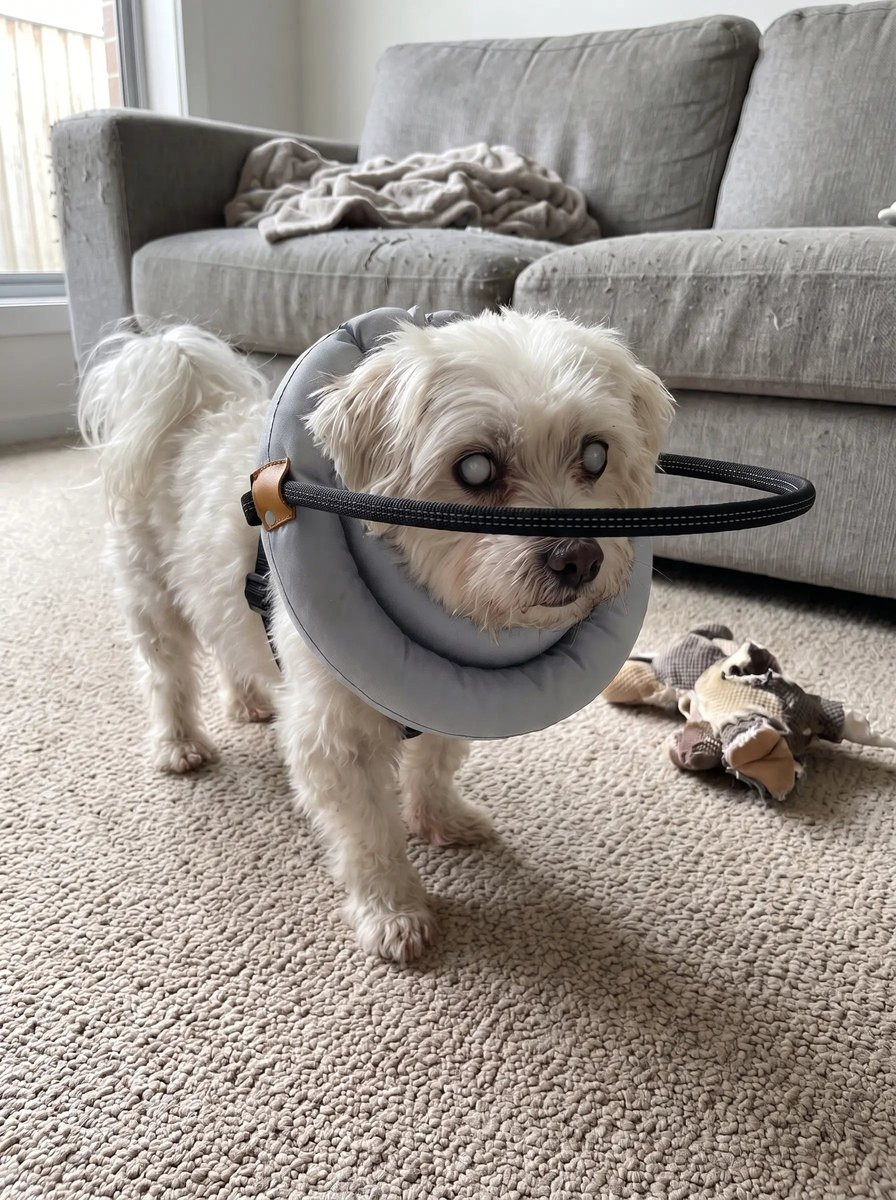
“Bella has cataracts in both eyes and the vet said surgery wasn’t an option at her age. She was walking into the hallway walls so hard I could hear it from the other room, and she stopped leaving the living room. Two weeks with the ring on and she’s doing the hallway again — bumps it, turns, keeps going like it’s nothing.”

“Peanut had both eyes removed in March because of glaucoma and I honestly didn’t know how he was going to live like that. He was so scared he’d just freeze in the middle of the room and shake. With the ring on he started exploring again — slowly, but he does it.”

“Our lab mix is 14 and went blind this year. He got scared of walking around the house and just stayed in his bed all day. I have arthritis in my hands and the buckles are easy enough for me to do on my own. He’s moving around again — my wife cried the first time he walked into the kitchen by himself.”
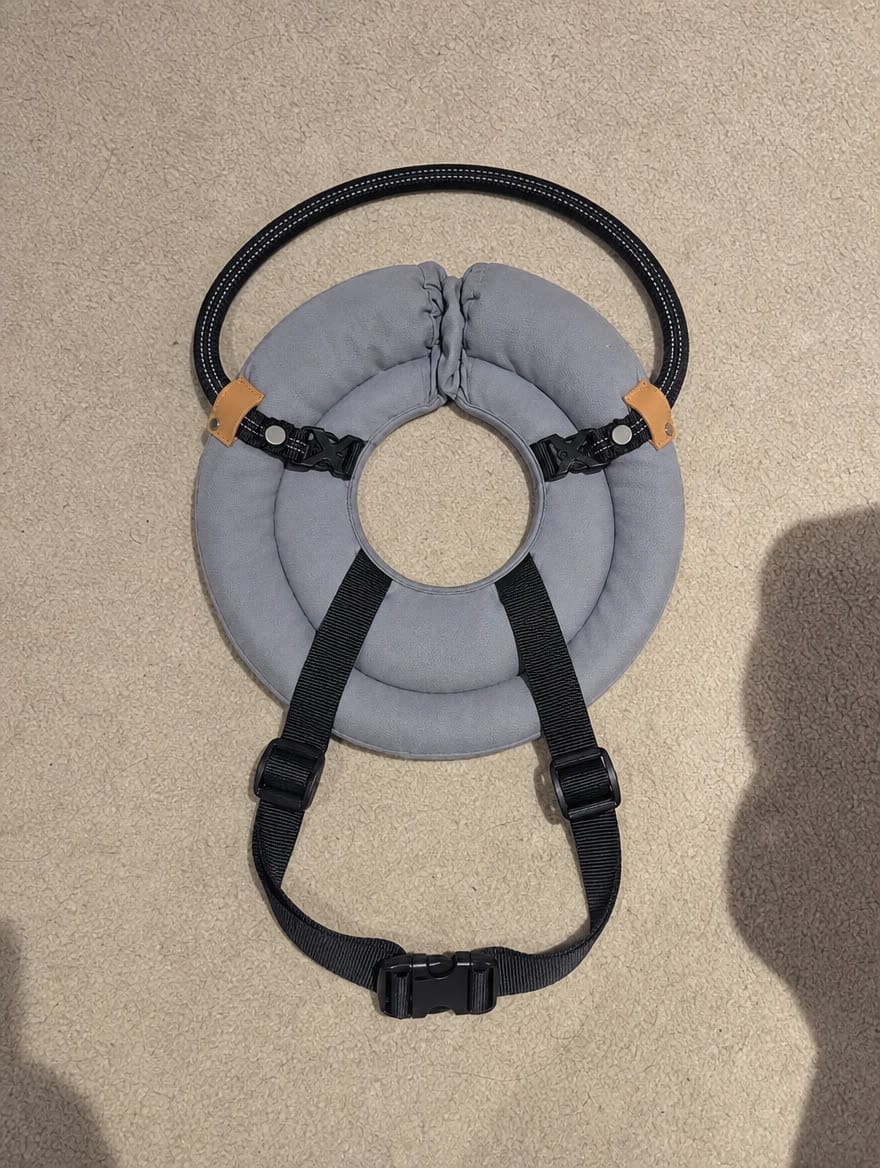
“I was nervous about the size so I measured her neck and snout like the chart says and ordered the M, fits perfect. the ring sits right in front of her nose with a little room so she hits stuff with it and not her face.”
If he won’t wear it,
you shouldn’t pay for it.
Some dogs take to the ring in ten minutes. Others need a week of short sessions and a lot of treats. You have 90 days to see which one your dog is — and if it still isn’t working, ask for a refund on legitimate grounds and we’ll sort it out without an argument.
The things people ask before buying.
Which size should I choose?
Measure around the neck where a collar sits, then the length of the muzzle from the corner of the eye to the nose tip. Match both numbers in the table above. If your dog is between two sizes, take the larger one — every strap adjusts down.
Can they eat and drink with it on?
Yes. The halo sits above and in front of the face, so the bowl stays reachable and the muzzle is free. Most dogs eat exactly as they did before.
How long does it take them to get used to it?
Every dog is different. Some settle in minutes, others need a few days. Start with short sessions, plenty of treats and praise, and add a little time each day.
Does it help a senior dog who gets disoriented?
It helps with the bumps — furniture, corners, doorframes. If your dog has advanced confusion or starts pacing into walls at night, introduce it slowly and talk to your vet about what else might be going on.
Can they sleep in it?
They can lie down with it on, and many do. For sleep and long naps we recommend taking it off so they can stretch out and turn over without the ring in the way.
Can we still go for walks?
Yes. The leash clips onto the chest harness exactly like a normal harness, and the ring keeps the head from running into poles, fence posts and patio chairs.
Will it fit a flat-faced dog?
Pugs, French bulldogs and Boston terriers usually need to go one size up on the muzzle measurement, because the ring has to clear a shorter nose. Measure carefully and size up if it’s close.
What if my dog panics the first time?
Take it off, let him settle, and try again later with the ring held near him first. Ten seconds on, treat, off. Build up from there. If he stays distressed, stop and ask your vet or a trainer for help.
He still wants to walk the whole house.
The ring doesn’t give his sight back. It gives him permission to move again — and gives you one less thing to listen for at night.